Jessica Moore Harjo continues family legacy, building community through art, collaboration
(TVLSE, Okla.) Jessica Moore Harjo never expected her love of design to grow into a career producing Indigenous fashion shows and helping other Native designers gain visibility.
Harjo, who is of Otoe-Missouria, Osage, Pawnee and Sac and Fox descent, was raised in an artistic family. Her father, Ted “Ruski” Moore, Jr., was a respected Osage artist and art teacher, and Harjo grew up watching his paintings come to life.
Hoping to apply her love of art professionally, Harjo set out to become a landscape architect.
While studying landscape architecture at Oklahoma State University, Harjo considered switching her major to graphic design to focus more on digital art. She recalls being discouraged when she asked the department for advice.
“They basically told me I wouldn’t be able to make it,” Harjo said.
Taking their advice, Harjo continued her original plan of study, graduating with a bachelor's in landscape architecture and a minor in studio arts. But her interest in graphic design was as strong as ever, so she went on to get her master’s and doctorate in design from the University of Minnesota.
Since then, Harjo has produced public sculptures, jewelry, clothing and collaborations with artists from many tribes. Today, her work focuses primarily on fashion and jewelry across artistic media; she calls herself an interdisciplinary artist.
“I use the word ‘interdisciplinary’ because, at my core, I'm a digital artist,” Harjo said. “And that digital art kind of bleeds into all these intersections of public art, wearable art, fashion and graphic design.”
Her work often includes floral patterns, geometric shapes, ribbonwork designs and imagery inspired by the natural world.
Over the years, Harjo’s art has been featured in many exhibits, including at the First Americans Museum, Philbrook Museum of Art and Osage Nation Museum. In June 2023, her sculpture, “People of the Great Sky, Constellations of the Land,” was installed at the Oklahoma State Capitol.

A focus on fashion
As her career grew, Harjo began exploring fashion as artistic expression. Soon, she began collaborating with her sister, Erica Pretty Eagle Cozad, who is also a designer. The two combined their interests in art, design and clothing and, about a decade ago, began plans to start a creative business.
They wanted their brand to reflect what they hoped to accomplish, so they removed the vowels from the word “empowered,” and MPWRD was born.
As the sisters took on more and more fashion projects, they began toying with the idea of curating their own fashion show.
In 2023, they organized the first MPWRD Indigenous Fashion Show at Osage Casino in Tulsa. The event gave Indigenous designers a chance to showcase their clothing on the runway and introduce audiences to different styles of contemporary Native fashion.
The sisters planned to make MPWRD a biennial event, but tragedy changed their plans.
From grief, inspiration
In September 2025, Harjo and Cozad’s father died. The loss affected the sisters personally and artistically, and the fashion show was shelved.
But as she worked through her grief, Harjo found inspiration in her father’s art.
“I have this really beautiful painting that my dad did, and it's a golden eagle,” she said. “It’s one of his last paintings he did before passing. I feel like it's him in a form of protection.”
She designed a new collection, centering the eagle and its role in Native culture and her own experience. The Eagle Collection allowed her to re-engage with art in a new way as an expression of her grief and love. The process also reminded her why she enjoys creating. Harjo's work isn’t always about producing something to sell or even display. Sometimes, the process itself is a crucial way for her to deal with what is happening in her life.
For Harjo, art is about how people respond to it. Her own emotional experiences making art are only part of the equation; she also creates to experience how audiences will respond. She believes art can bring out emotions people don’t always know how to express.
“If I can create something that makes you feel happy, feel whatever emotion that you might need through art, then I think that’s really powerful,” she said.
A celestial return
Harjo and Cozad eventually returned to their plans for another MPWRD fashion show, rethinking the production, involving more people and developing a meaningful theme.
On October 17, 2026, the fashion show returned as NOVA: An MPWRD Fashion Show Production. The celestial theme invited participating Indigenous designers to interpret the theme through their own cultural traditions involving the sky, stars and the cosmos.
“How do you relate to the stars in your own way, your own interpretation?” Harjo said, describing how the sisters hoped designers would apply the theme.
The event drew a strong crowd and community support, and the sisters hope to plan another when the stars align and they have the time and collaborators needed for another successful show.
The next venture
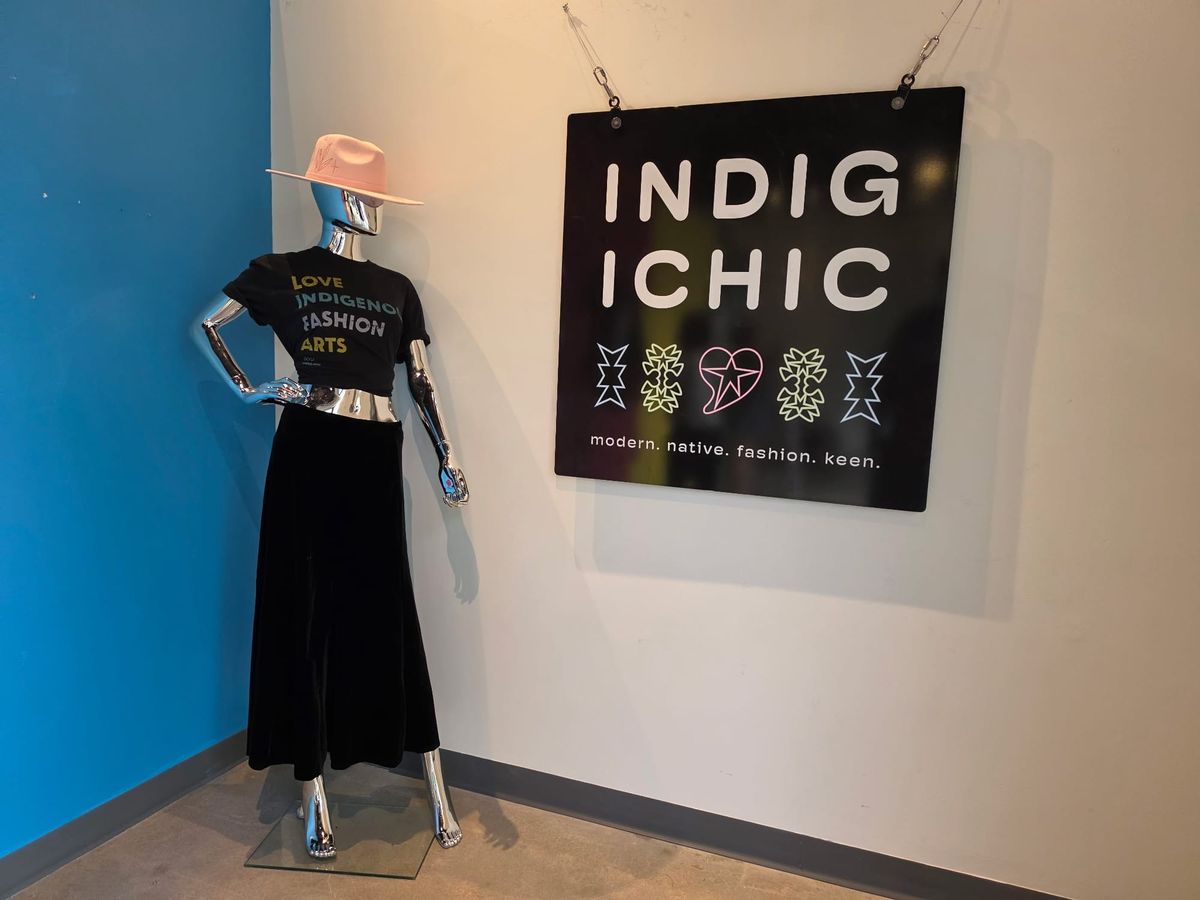
While MPWRD has given Indigenous designers a chance to showcase their work on the runway, another of Harjo’s projects helps them sell their creations. INDIGICHIC, a contemporary Indigenous fashion and arts boutique, features one-of-a-kind clothing, jewelry and accessories designed by Native artists and entrepreneurs.
The project has been in the works since Wilson Pipestem, owner of Pipestem Law, approached Harjo four years ago with a proposition. He wanted to open a store in Tulsa where she could sell Weompe Designs. Harjo liked the idea, but she questioned why it should only feature her designs.
“I can’t just have a store for me,” she said. “What about other artists?”
The conversations that followed between Harjo, Wilson Pipestem, and artist Veronica Pipestem sparked the idea for a Tulsa boutique featuring Indigenous art, clothing, jewelry, accessories and other handmade products from artists with diverse tribal backgrounds.
The three eventually brought in artist Alex Ponca Stock and together created the Native Fashion Arts Collective behind INDIGICHIC.
The founders knew one another through the Gray Horse Osage community, but running a retail business together was a new experience. Their first challenge was determining whether people would shop at a business like INDIGICHIC.
Instead of signing a long-term lease, they decided to try out a less conventional business model: They would introduce INDIGICHIC as a seasonal pop-up store. The first season was a hit, and the founders felt encouraged to continue developing the business, with grant funding helping cover operating expenses.
INDIGICHIC has now launched three seasonal boutiques, with each new season bringing new lessons about managing a store, organizing merchandise and working with artists. Those experiences have shaped their decisions about where to open each season and whether INDIGICHIC could eventually operate year-round.
This approach has allowed INDIGICHIC to grow from a small experiment to a seasonal boutique featuring work from dozens of Indigenous creators.
INDIGICHIC’s next pop-up
INDIGICHIC is set to begin its fourth season on Saturday, Oct. 31, at its new location at 317B South Trenton Avenue, on Studio Row in Tulsa. The seasonal boutique will be open through Jan. 8, 2027.
Around 30 Native artists will participate this season, bringing a variety of styles and products to the boutique. The selections will change throughout the season as artists rotate their merchandise. As Christmas approaches, shoppers can expect more holiday merchandise, including ornaments and gift sets. Customers can stay updated on new arrivals by subscribing to the store’s newsletter.
The INDIGICHIC grand re-opening on Oct. 31 will be held from 10 a.m. to 6 p.m., with an artist reception and light refreshments from 2 to 5 p.m.
Visitors can browse clothing, jewelry, accessories and other merchandise while meeting some of the artists whose work is featured in the store. There will be a door prize drawing for customers who arrive wearing their Halloween costumes.
Saturday’s grand reopening is another step toward what the collaborators envisioned when they first launched INDIGICHIC, and what Harjo has worked toward throughout her career: space where Indigenous artists are celebrated.