Reflecting on an era of fortune and deviousness: The Jackson Barnett saga

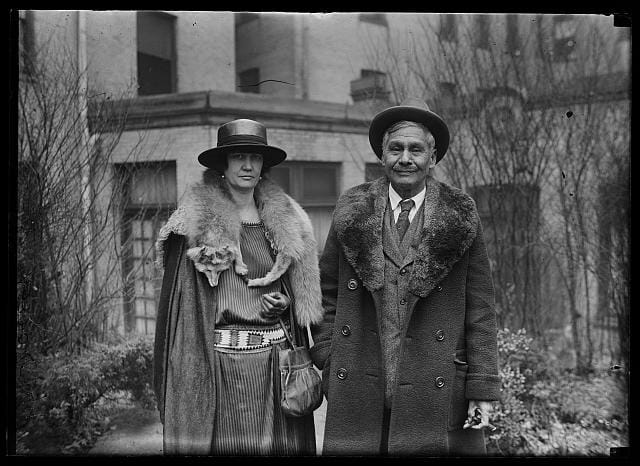
Photo Courtesy: Library of Congress
Written By Noel Lyn Smith
(OKLAHOMA) Ronald Barnett recalled a time in 2022, when he stood on a patch of eastern Oklahoma land that once belonged to his great-great-great-uncle.
“It was just like a one room hut, and the fireplace was right in the center of the house,” he said about a structure that still stands to this day. It was a place his relative, Jackson Barnett, called home for many years before his life was upended after oil leases made him substantially wealthy.
The oil well that catapulted him into fame as “The World’s Richest Indian” was dug nearly 3,000 feet deep just outside the Creek County town of Drumright in 1912. The well was deemed a “gusher,” and its production peaked at 18,000 barrels a day, according to the National Register of Historic Places.
The discovery made Jackson Barnett a millionaire. It also provided his life with a series of baffling and sinister turns.
This reporting was supported by theInternational Women’s Media Foundation’s Fund for Indigenous Journalists: Reporting on Missing and Murdered Indigenous Women, Girls, Two Spirit and Transgender People (MMIWG2T).
Jackson Barnett died in 1934 and he left no will. It took legal proceedings to settle his estate, resulting in the family no longer owning that patch of land, according to Ronald Barnett. To see the structure his great-great-great-uncle once lived in, he had to first receive permission from the current property owners.
Retracing the riches
By the early 20th century, the so-called Indian Wars had subsided, resulting in most tribes across the U.S. being forced onto reservations. These were often lands deemed unsuitable or unappealing to white settlers and developers.
Jackson Barnett was a full-blooded Muscogee Creek Native who was able to own his land because of amendments to the General Allotment Act of 1887 (also known as the Dawes Act), which designated 160 acres of land to Native Americans.
Members of the Cherokee, Chickasaw, Choctaw, Muscogee Creek and Seminole were among those Native nations initially exempted from the act, but they were later included in the law through Congressional amendments. The first land allotments for the five tribes began in July 1902.
For the first decade, Jackson Barnett spent a quiet and simple life on his land. But after oil was discovered, he quickly became a millionaire, placing him into a life of wealth and status. This notoriety also made him a target of corrupt and greedy non-Natives, a common fate by many other Natives in Oklahoma who outsiders saw as ripe for exploitation because of their sudden influx of wealth.
For instance, part of Jackson Barnett’s troubling history included him disappearing — then reappearing — married to a non-Native woman outside Oklahoma.
A profitable marriage, a legacy of resentment
When crews began extracting oil from Jackson Barnett’s land in 1912, the overnight millionaire found himself deemed incompetent by Oklahoma courts and guardians were appointed to oversee his business transactions.
For many years, Jackson Barnett was labeled as simple or “off” by locals after he fell from a horse in his youth and sustained a head injury. However, many historians and Native researchers point out that many Oklahoma Natives who became rich with oil royalties were deemed incompetent, and this was part of a coordinated campaign to cheat them out of their fortunes.
The Indian Rights Association (IRA) monitored and documented Jackson Barnett’s situation. The association was founded in 1882 and it was supportive of assimilating Native people into mainstream culture, including dividing tribal lands into individual allotments.
But they also looked into how the legal rights of Oklahoma Natives fared under the state’s probate laws.
IRA archives and a report from a U.S. House committee detailed Jackson Barnett’s abduction in February 1920 by Anna Laura Lowe, a non-Native woman who also went by the name Mary Lowe.
The report stated that Barnett’s “great wealth” is what made him attractive to Lowe, who was known to have an “unsavory past” and, in her pursuit of money, was reported to have engaged in “immoral and criminal practices.”
Lowe drove herself and Barnett to the county-seat towns of Okemah and Holdenville, “in the endeavor to secure a marriage license and to consummate a marriage with him,” the report states. When those efforts failed, she drove him to Kansas and then Missouri, where marriage ceremonies in both states were successful.
In 1923, the couple moved to Los Angeles. That same year, a law office in Tulsa sent the IRA an affidavit by an alleged witness to the conspiracy, packed full of allegations against Lowe, including a plot to steal a baby and pass it off as hers and Barnett’s.
This reporting was supported by theInternational Women’s Media Foundation’s Fund for Indigenous Journalists: Reporting on Missing and Murdered Indigenous Women, Girls, Two Spirit and Transgender People (MMIWG2T).