You all come eat: Eugenia “Carol” Tiger and family carry Mvskoke food traditions forward

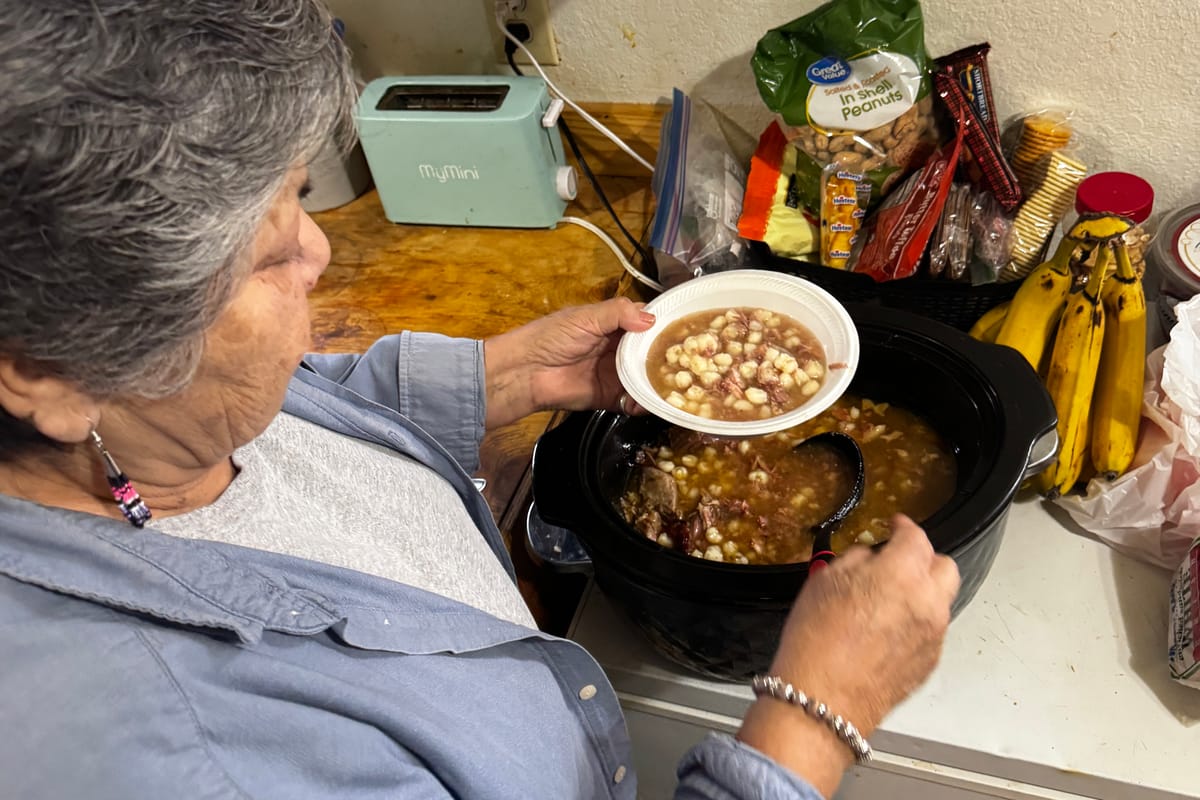
(OKEMAH, Okla.) Eugenia “Carol” Tiger has spent a lifetime preparing meals that bring people together. The Mvskoke elder continues that work through Hompvks Ce, a Mvskoke homestyle cooking and catering effort dedicated to traditional foods, healthier preparation and teaching future generations.
Hompvks Ce, Mvskoke for “you all come eat,” is more than a business name. For Tiger, it represents gathering, shared meals and community connection.
“It means everybody comes together,” she said. “You sit around the table, visit with each other, talk with each other. Everybody has a seat at that table.”
Tiger grew up in a large family and learned to cook at a young age, helping her mother in the kitchen and learning by watching elders. Later, as a single parent raising three daughters, cooking became both a necessity and a way of caring for her family. She worked for 37 years before retiring in 2012, after which she began cooking for numerous events.
“I started cooking more and more after I retired,” Tiger said. “I was cooking for churches, for Mvskoke Nation youth groups, and it just kind of went from there.”
She also cooked for festivals and traditional wild onion dinners, preparing foods such as grape dumplings, chicken and dumplings, fry bread, sofke, pumpkin dishes, and hominy and meat. Tiger became known for her traditional yet health-minded approach.
“I wanted to cook the old way, but a healthier way,” she said. “I didn’t want food swimming in grease. If it didn’t taste good to me, I wouldn’t want nobody else to eat it.”
Tiger’s approach to cooking developed early in life, after her father passed away from complications related to diabetes and high blood pressure.
“I was still young when I started changing the way I cooked,” Tiger said. “I wanted to live longer, and I knew food had a lot to do with that.”
Tiger emphasizes balance rather than restriction when it comes to traditional foods. She explained that many Indigenous dishes are eaten only occasionally today, often at community gatherings or special events.
“How often do people really get to eat these foods?” she asked. “Maybe once or twice a year. That’s different than eating fast food all the time, which is what really makes people sick.”
In recent years, Tiger and her daughters have begun offering traditional food classes for women and girls, focusing on passing down knowledge rather than commercialization.
“I tell them, this is for you and your family,” Tiger said. “I don’t want you selling it. I want you to learn it, practice it and carry it on in your family.”
She also believes learning to cook must be a hands-on effort.
“I don’t want to just give somebody a piece of paper,” she said. “I want to show them how. That’s how I learned.”
Tiger’s daughter, Cassandra “KC” Thompson, plays a key role in preserving and sharing Tiger’s knowledge. Thompson helps create dishes alongside her mother and manages the digital side of Hompvks Ce, including social media and cooking videos.
“When I first started her Facebook page, it was really just to document all the food she makes,” Thompson said. “Videos and posts are history now, and I wanted my kids, my nieces and nephews, to have that.”
Thompson said she did not always see herself in the kitchen, but that changed as her children and her mother grew older.
“Now that my mom is getting older, I know I have to learn these dishes,” she said. “That’s what my kids request for their birthday: foods like dumplings, hominy and meat, sofke.”
Beyond recipes, Thompson said cooking with her mother has taught her patience.
“There are no shortcuts,” she said. “You have to trust the process, listen and pay attention to every detail.”
Thompson also highlighted her mother’s belief that food preparation is a form of care. For Tiger, cooking is not just about nourishment, but about intention and energy. She believes a meal reflects the mindset of the person preparing it.
“You can’t cook mad,” she said. “You have to take your time. If you rush it, it doesn’t turn out right.”
Thompson said that belief carries into every meal her mother prepares.
“She prays over her food,” Thompson said. “She believes it won’t turn out right if you cook with a bad attitude.” This type of focused energy is just as important as the ingredients.
While her mother does most of the cooking, Thompson sees her role as a bridge between generations, combining traditional food knowledge with modern tools.
“Everybody has a role,” she said. “Mom has the knowledge. I’m more of the digital person for video, social media, so it can reach people who don’t live here anymore.”
She said many people attending Tiger’s cooking classes are reconnecting with foods they remember from childhood.
“They remember the taste,” Thompson said. “They want that feeling back in their homes, and they don’t always know how to make it.”
Looking ahead, the family hopes to create a recipe book to further preserve Tiger’s teachings.
For Tiger, the work is about ensuring knowledge continues beyond her lifetime.
“I hope people keep asking me how to make things,” she said. “I’m here to show them.”
As long as people are willing to learn, Tiger said, the table will stay full, and the invitation will always remain the same: Hompvks ce. You all come eat.
Carol Tiger’s Beef Stew
Ingredients
- 1 ½ lb. roast beef, cut into chunks
- 4 cubes beef bouillon
- 1 medium onion, diced
- 4 celery stalks, diced
- 3 medium potatoes, diced
- 2 cans diced tomatoes, undrained
- 2 cans tomato soup
- 1 can diced tomato with green chilis (such as Rotel), undrained
- 2 cans mixed vegetables, undrained, or 32 oz. bag frozen mixed vegetables
- Salt and pepper
Directions
- Heat oven to 365 degrees.
- Place beef and bouillon cubes in a large roasting pan.
- Cover meat with water and bake 2 hours or until tender.
- Transfer meat and juices to a crockpot and continue cooking on high for 3 hours.
- In large saute pan, saute 1/4 c. of onions, celery and potatoes until tender.
- Add meat and juices, along with all tomatoes and vegetables, to the saute pan. Let simmer for 30 minutes. Season to taste.