Exploring Turtle Island Through the Centuries-Long Connections of Indigenous Nations

Written By Rachael Schuit and Troy Littledeer
(TURTLE ISLAND) The United States recently marked the 250th anniversary of its founding. But long before the United States or Canada existed, Indigenous Nations across North America, known by many Indigenous people as Turtle Island, maintained their own governments, trade networks, cultures and relationships with one another.
Canadian fused-glass and stained-glass artists Melinda Robertson (Anishinaabe–Lake Manitoba First Nation) and Shannon Monk (Anisininew–St. Theresa Point First Nation, Mi’kmaq–Lennox Island First Nation and Celtic–Nova Scotia) are using their artwork to showcase those longstanding connections.
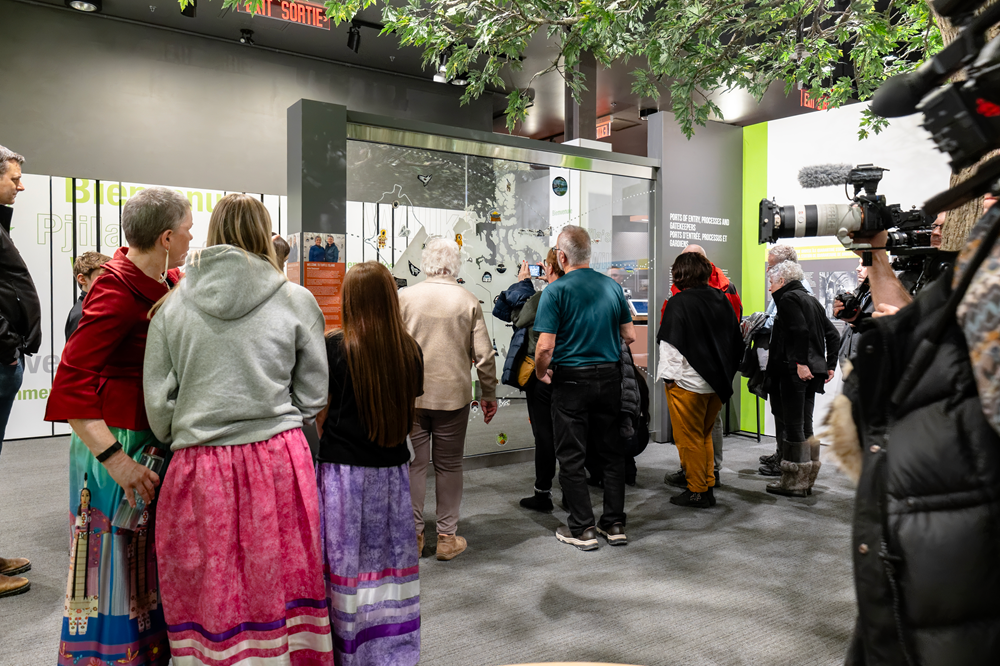
Their work is currently displayed on a large glass map at the Canadian Museum of Immigration at Pier 21 in Halifax, Nova Scotia, as part of an exhibit called Welcome to Turtle Island.
Monk says the exhibit is designed to offer a different perspective on immigration.
“When we hear about immigration we’re always hearing about newcomers to this country kind of as a more recent phenomenon,” said Monk. “Anyone who is not indigenous is an immigrant, is a newcomer to the country, but there’s a lot of people in Canada and the U.S. who have six, seven generation ties to the country so they would never consider themselves immigrants so we just wanted to introduce that concept and that understanding, that immigration extends even beyond those deep family connections to what is now Canada and the USA.”
When designing the exhibit, Monk and Robertson intentionally extended the map beyond Canada’s present-day borders.
“If we were going to tell the story of immigration from an Indigenous lens, it was important that it wasn’t just Canada, that it was Turtle Island and so we actually drew in all of the U.S. and land borders, land masses, and wanted to make sure that we could show that Turtle Island extended beyond Canada,” said Monk.
Monk and Robertson studied Indigenous linguistic groups and tribal and First Nations affiliations, creating individual glass pieces representing food, agriculture, hunting, shelter, clothing, ceremonies, governance and other elements that were unique to different communities
The pieces attached to the larger map include a basket of berries, Iñupiat ceremonial winter clothing and a lacrosse player.
“We really see this as an important educational tool,” said Monk. “We tried to do the full gamut of what a society participates in. Some of these teachings and experiences and practices are shared experiences all across Turtle Island, where others are very distinct and unique.”
The relationships represented in the exhibit remain visible today, including within Oklahoma. Indigenous Nations and families continue to maintain connections across the international boundary separating the United States and Canada, a border created centuries after their homelands, governments and kinship networks were established.
According to U.S. Census Bureau data from the 2024 American Community Survey, 787 Oklahoma residents identified with three Lakota Sioux tribes — the Rosebud Sioux Tribe (399), the Oglala Sioux Tribe (243) and the Cheyenne River Sioux Tribe (145). Each of those tribes has related Lakota and Dakota First Nations communities in Canada.
The same federal data shows 4,789 Oklahoma residents identified with the Blackfeet Tribe, the U.S. member of the Blackfoot Confederacy. The Confederacy also includes the Siksika, Kainai and Piikani First Nations in Alberta, Canada.
The international boundary bisects territory the Confederacy occupied long before the United States and Canada negotiated it into existence. Members of the Confederacy hold citizenship in both countries, and families have maintained cross-border relationships for generations.
The Haudenosaunee Confederacy, Anishinaabe and Cree Nations similarly span the border, with communities recognized by both the United States and Canada. The Turtle Mountain Band of Chippewa Indians, an Anishinaabe Nation in North Dakota, had 17 affiliated residents in Oklahoma according to the same census data.
The census data also recorded six Oklahoma residents affiliated with the Central Council of the Tlingit and Haida Indian Tribes, an Alaska Native government whose traditional territory extends into what is now British Columbia and the Yukon.
Even when a border between the U.S. and Canada was initially established, Indigenous people still had the right to go between the nations.
The border itself stems from agreements between the United States and Great Britain. The Jay Treaty of 1794 includes provisions addressing cross-border movement for Indigenous people. Article III of that treaty stated that Indigenous people had the right to pass and repass the border freely and to carry goods across without paying duty.
While passing freely may not be a reality anymore, Monk hopes the exhibit will help reinforce the idea that Turtle Island was occupied long before Europeans arrived.
“We had a nation of people who were quite capable of their own governance and existence, living life and innovating through different inventions and tools and having a thriving trade network,” said Monk. “It was really important to show this very, and I’m using the terms in quotes, just as civilized a society as the perceptions were that the land was empty.”
Monk said the exhibit has received positive feedback from visitors, many of whom are initially drawn to the beauty of the artwork before discovering the larger story it tells.
“They’re really intrigued because of course they’re drawn to the art,” said Monk. “And then I think the response has been overwhelmed, because I think people to tend to stereotype us and tend to have these very non-expansive kind of very linear, very small ideas of who we are and what we do and where we come from and so we really wanted to blow those ideas out of the water.”
Welcome to Turtle Island is on display through December of 2027. More information about visiting the exhibit can be found here.