“I don’t think they fully understand”: Owasso flag advances to vote despite concerns about Native imagery

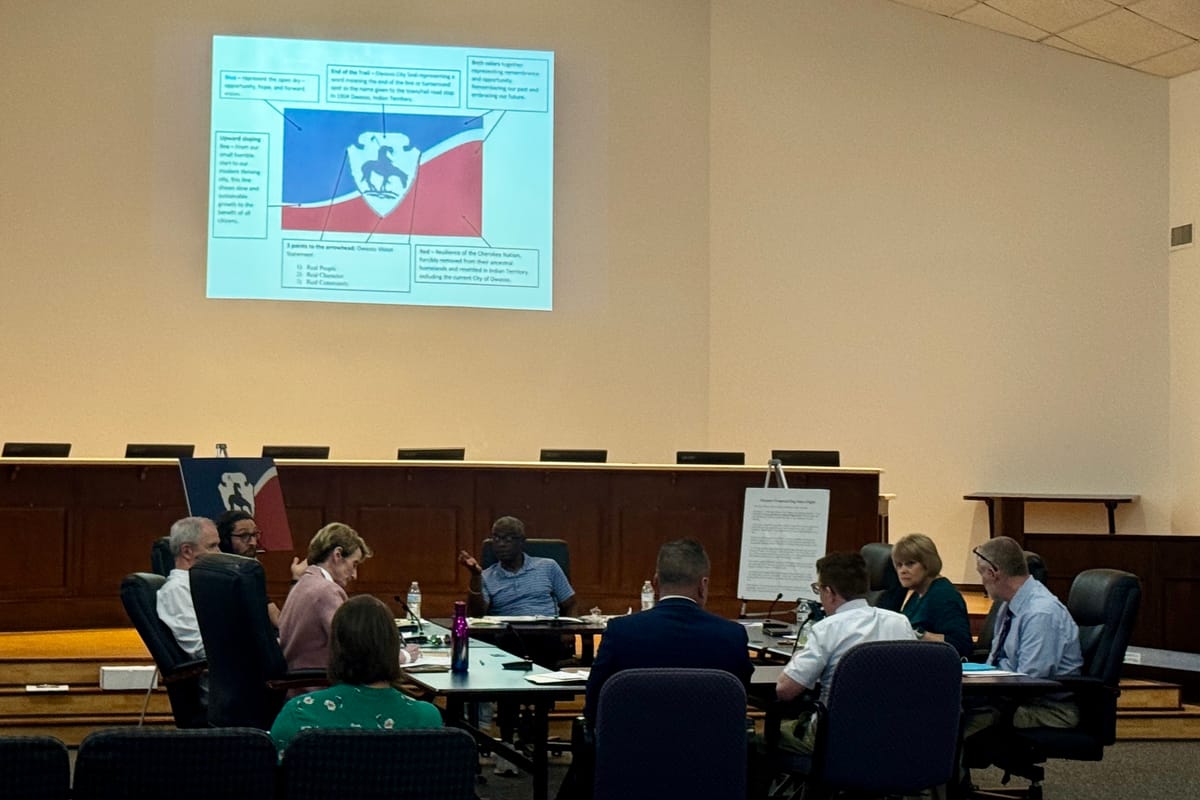
(OWASSO, Okla.) The City of Owasso is closer to adopting an official city flag following a joint meeting of the Owasso City Council, Owasso Public Works Authority and the Owasso Public Golf Authority Tuesday night, despite debate over the design’s use of Native American imagery.
The proposed flag was announced on social media in February, with Owasso residents invited to stop by City Hall or attend city council meetings on Feb. 17 and Mar. 3 to share their thoughts on the design, which was inspired by a local youth and created in partnership with local graphic designer Keith Whitfield.
Crosswinds News attended both city council meetings, but found neither agenda included a public comment item relating to the flag.
In order to get on the agenda to speak at an Owasso City Council meeting, community members must contact the Owasso City Clerk no later than 5 p.m. the Wednesday before that meeting, a requirement not mentioned in the social media invitation.
The proposed flag includes Native American imagery inspired by the "End of the Trail" sculpture, created by James Earle Fraser in 1894, a European American man influenced by his experiences with Plains Indians.
Comments on the flag announcement social post relating to the Native American imagery included:
“The Native American need(s) to be depicted as a strong warrior, not dejected with his head down. NOT good.”
“It is derogatory.”
“The fallen warrior is a NO.”
City of Owasso spokesperson Art Hadaway told Crosswinds News the city received a variety of responses at City Hall since revealing the proposed flag, but those responses would not be made public. The responses were, however, shared with the city council for further discussion ahead of Tuesday’s meeting.
That meeting was considered a “worksession” and did not allow for public comments.
Standing alongside the local youth artist, City of Owasso Assistant City Manager JJ Dossett said “End of the Trail” has been the city’s seal since the 1970s.
"So, this is something the people of Owasso, decades before us here today, had decided they wanted as the city seal," Dossett said.
According to the Metropolitan Museum of Art, Fraser created the sculpture depicting an exhausted Native man “to comment on the confinement of Native Americans on reservation land.”
Owasso is located entirely within the Cherokee Nation of Oklahoma (CNO) reservation.
Dossett described the Cooweescoowee District, where Owasso is located today, as historically “not where a large population of people lived but where there was a lot of land, and so therefore, land to raise animals on or hunt or those types of things."
Some historians and Native scholars consider this framing a colonial narrative used historically to justify settler expansion.
Dossett said the first thing they did regarding the seal's incorporation into the flag design was reach out to CNO Director of Government Relations Adam McCreery.
"I made sure that when they went through, they have a department, cultural art department, for this,” Dossett said. “I said, I need you to look at this and just give us feedback. If you hate it, if you love it, if whatever. And they came back and said that neither one. They said it was appropriate.”
Crosswinds News reached out to CNO for comment but has yet to hear back.
“I read all the comments and unless I'm off on my estimation, the majority of the comments were positive,” City Council Chair and Mayor Alvin Fruga said. “And you're not gonna get 100% buy-in, and we understand that.”
Dossett said he believes negativity around the imagery is a misunderstanding.
"I believe all the comments we are receiving about the actual image of the End of the Trail as negative, I don't think they fully understand why Oklahoma and Owasso originally embraced the image, is the way I would put that," Dossett said.
Owasso Councilman Cody Walter (Ward 1) was the lone voice raising concerns about how open the flag design process was.
“There may be ways to make this a more inclusive design process and not just an inclusive commentary process,” Walter said.
But the mayor and other council members defended the existing process and ultimately decided to move forward with the current design rather than inviting additional submissions.
Fruga said he didn’t want to ask the public for any more designs.
“It sends a message that we didn’t do it right the first time,” Fruga said.
Ultimately, the city council moved the resolution forward, with the vote to adopt the design as Owasso’s flag being held as early as the next council meeting (March 17) or the first one in April (April 7).
Owasso City Council meetings are held at 6:30 p.m. the first and third Tuesday of each month
Additional public comment would require community members to request placement on the agenda through the city clerk.