Mekko Acee Yahola: First Mayor of Tulsa

Tulsa’s best kept secret may be that its first mayor was Acee (aka Archie) Yahola who was Mekko of the Locv Pokv tribal town. Or perhaps the biggest unknown to Tulsans is that the name Tulsa derives from the Mvskoke word ‘Tvlvhassee, meaning Old Town. Tulsa’s deep and rich Mvskoke roots have been minimized for far too long. Most Tulsans would say, for example, that the first historical mention of the town was in 1882 with the arrival of the railroad. Or they may point to 1898 when Tulsa was officially incorporated. They are shocked to learn that the first historical mention of Tulsa/Tvlvhassee was nearly 500 years ago in 1540 by Desoto. So even in 1540 ‘Tvlvhassee was known as “Old Town”.
Mekko Yahola led the Locv Pokv tribal town on the Trail of Tears in the fall of 1836. They began their forced death march from present day Loachapoka, AL. They were in one of five major detachments that fall in the systematic ethnic cleansings of 20,000 Creeks from the Southeast U.S. The Locv Pokv were forced marched 650 miles which took about two months. After their arrival at Ft. Gibson, Mekko Yahola led the tribal town up the Arkansas River where they settled in this area we today call Tulsa.
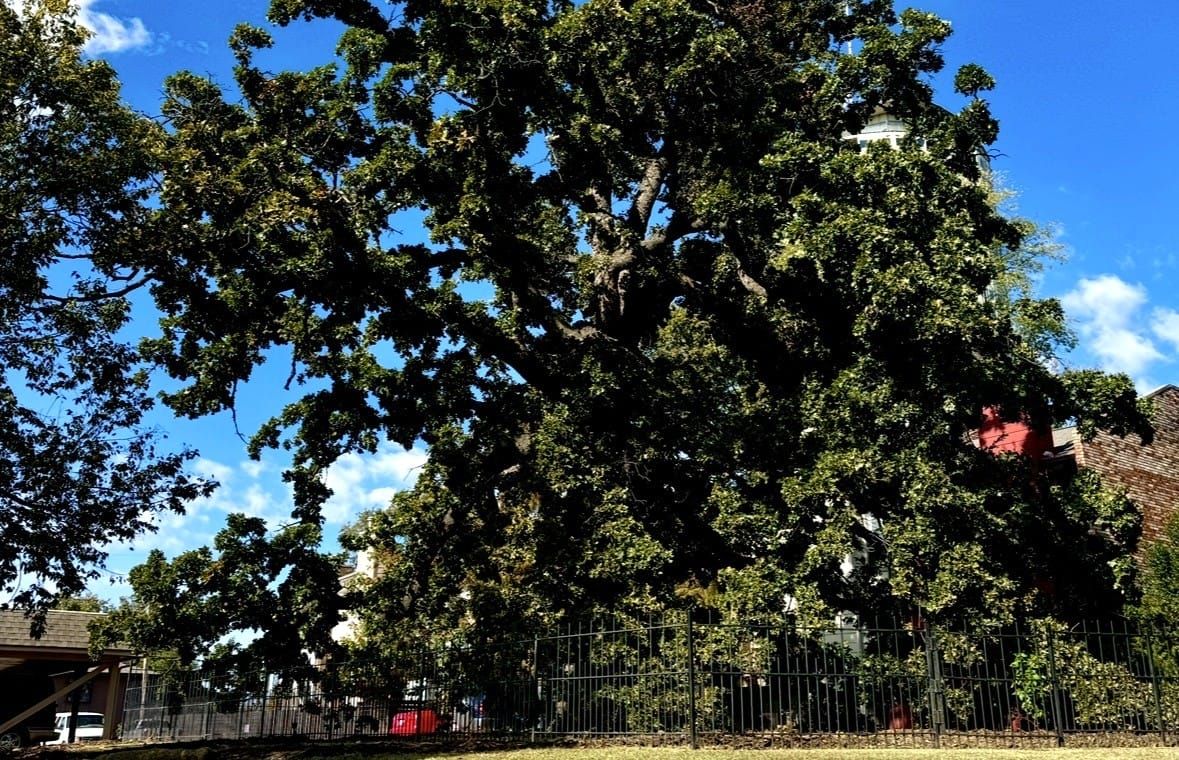
The site where the Locv Pokv decided to rebuild their tribal town offered numerous advantages. It was up on a hill which afforded a 360-degree view surrounding them. Water was plentiful in the nearby Arkansas River. Fish and game abounded. However, I am convinced that the sight of the Council Oak tree was taken as an omen of good fortune and the deciding factor in the decision to rebuild there. In the homelands, the Locv Pokv had settled around another tree called the Great Council Oak tree. I’ve seen old photos of the Great Council Oak tree, and it bears a striking resemblance to the Council Oak tree. These two oak trees framed the beginning and end for the elegy we know today as the Trail of Tears.
As the esteemed historian Angie Debo has written, the Locv Pokv rebuilt their tribal town with remarkable exactness to what it looked in the homelands. Under the leadership of Mekko Yahola, the tribal town blossomed. The Council Oak tree stood at the southeastern corner of the town square. The cuko polokse, the roundhouse (also called the hothouse) was located at the northwest corner of the town square. Ironically, the circular University Club Tower now stands in the same spot. Cultivated communal cornfields were located nearby. For the Locv Pokv, life returned to some sense of normalcy in these alien lands.
Mekko Yahola built his cabin nearby and just to the north of the Council Oak. A January 5, 1992, story in the Tulsa World reports that his water well was discovered during construction activity at the southeast corner of 12th street and Boulder Ave. The water well was ten feet deep and lined with limestone. This would also confirm Debo’s statement that Mekko Yahola’s house was “just southwest of the bend in Main Street.” Mekko Yahola walked on in 1850 during a smallpox epidemic. He was buried near his home which stood between 11th and 12th streets along Boulder Ave. That is the present location of the First Methodist Church.
In addition to Debo, the Indian Pioneer Papers (IPP) oral history collection appears to confirm that Mekko Yahola is buried beneath the buildings of First Methodist Church. The IPP consists of hundreds of first-person interviews conducted in the 1930s. These elders had lived in Indian Territory prior to Oklahoma statehood in 1907. Many of these interviews centered on the “founding” of Tulsa.
Of note is a particular interview with D.O. Giles on June 30, 1937. During that interview he talks about abandoned cemeteries in Tulsa. Mr. Giles stated, “Then there was one at what is known as Twelfth and Boulder where the Stanley-McCune Funeral Home is…there was quite a scope of graves at Twelfth and Boulder, not more than a fourth of them were moved.”
First Methodist Church began excavation work for their new cathedral at 1115 S. Boulder in 1921. In 1924, the Stanley-McCune funeral home was built next door at 1127 S. Boulder. These are the sites that historical references inform us was the location of Mekko Yahola’s burial place and the early graveyard for the Locv Pokv. Tulsa has literally buried this history. It would seem a good and appropriate step to honor The First Mayor of Tulsa and the Locv Pokv with a historical marker. Tulsa’s deep and rich Mvskoke roots have been minimized for far too long.
Sour Sofkee is a column written by Native author and historian J.D. Colbert (Muscogee Creek, Chickasaw, Cherokee and Citizen Potawatomi) under the pen name Fus Yvhikv ("Singing Bird"). He writes across a broad variety of topics to include such genres as op/eds, comedy, fiction, political satire, history, and current events. His pen name is in homage to Alexander Posey who wrote under the pen name Fus Fixico ("Heartless Bird") and the Sour Sofkee column name honors William E. Moore (Mvskoke) who wrote a Mvskoke Dialect column for the Tulsa World in the 1930s which was titled Sour Sofkee.