Missing and murdered, yet underreported

Written By: Carrie Johnson and Rachael Schuit
Trigger Warning: This story contains information about violence, death, and missing persons that may be distressing to some readers. Please proceed with caution and prioritize your mental and emotional well-being. If you need support, consider speaking to a mental health professional by calling 988, texting the Crisis Text Line at 741741, or reaching out to a trusted person in your life.
The Missing and Murdered Indigenous People (MMIP) continues to devastate Native communities across Indian Country. Aside from the immediate grief caused by the deaths and unresolved disappearances of Native people, some Native Americans say a lack of press adds insult to injury.
Amber Davis, a member of the Muscogee Nation who serves on the board of directors for the Missing and Murdered Indigenous People (MMIP) Central Oklahoma Chapter, describes the media landscape surrounding MMIP as deeply complex.
“Mainstream media, they don't pick it up. They just don't pick it up,” she said.
Meanwhile, tribal media traditionally stick to news about their own tribal members.
This reporting was supported by theInternational Women’s Media Foundation’s Fund for Indigenous Journalists: Reporting on Missing and Murdered Indigenous Women, Girls, Two Spirit and Transgender People (MMIWG2T).
When the mainstream media does pick up a missing person case, Davis said, it usually involves a non-Native person.
“There was one last year where we had a MMIW case, a girl that was missing who was missing with a non-Native girl about her same age,” Davis said. “And everywhere you would turn, you would see the story about the non-Native girl that was missing. But we had to fight and really get the message out: Hey, we care about our Native girl as well.”
Davis isn’t the only one who laments the lack of MMIP coverage. Even news professionals are sounding the alarm.
“I think about it all the time,” said Troy Littledeer, a Keetoowah Cherokee journalist and freelancer for Osage News. “How are people just disappearing, and nobody cares?”
When it comes to tribal media, tribal affiliation and editorial focus aren’t the only reasons for the gap between crisis and coverage.
“For decades, mainstream news only showed up to talk about "the poor Indians" or use stereotypes that made communities look dangerous,” said Littledeer. “Those stories weren't just insulting; they cost tribes actual funding and messed up federal laws. Being cautious became a survival skill for tribal leaders. They learned that letting a reporter in usually meant getting stabbed in the back, so they started locking the doors to information to keep the community safe from more bad policy.”
A Long History of Media Harm
Media apathy for Native American injustice goes back centuries, dating back to the 1600s and colonial era.
Fair.org, an organization that challenges bias in the media, explored this topic in “The Colonial Roots of Media’s Racial Narratives” back in 2012. The piece cited an article published by Benjamin Franklin in 1764 about a mob of white people who murdered 20 Native Americans who were living peacefully among Quakers in Lancaster County, Pennsylvania.
Franklin wrote, “These poor defenseless creatures were immediately fired upon, stabbed, and hatcheted to Death. All of them were scalped and otherwise horribly mangled.”
According to FAIR, the other two newspapers in the area, The Pennsylvania Journal and The Pennsylvania Gazette did not report on the incident other than to share the Governor’s condemnation of the incident and share reward information for the killers.
Native Americans, on the other hand, were widely portrayed as violent.
In his book “The Newspaper Indian: Native American Identity in the Press, 1820-1890”, John M. Coward wrote, “To say Native Americans received ‘bad press’ during the nineteenth century is to state the obvious. Typically, a short telegraphic report from the frontier described ‘hostile’ Indians maiming, mutilating, kidnapping, and killing white men, women, and children.”
This problematic mainstream media coverage also included hypervisibility of alcoholism and drugs, often without context as to how both were weaponized in Native communities.
Inaccurate portrayals of events in Native communities and Native Americans themselves continued into the 1900s. The Creek Draft Rebellion is a more recent example of inaccurate Native American narratives being widely reported.
“Wartime Hysteria and Indian Baiting in WWI Oklahoma”, a research article written by Thomas A. Britten in 2001, examines the way Muscogee (Creek) Citizen Ellen Perryman and a 1918 event were greatly distorted by the media. Perryman had been working to secure a pension for her father, Wright Perryman, who she said served in the Union Army during the Civil War. As part of a broader effort to recognize Mvskoke service, she organized a meeting at the Hickory Stomp Grounds near Henryetta.
Britten wrote, “She attempted to organize a Grand Army of the Republic (GAR) post to commemorate loyal Creeks during the war.” However, the event turned into a protest against Woodrow Wilson’s administration and the requirements for all eligible men, including Native Americans, to register for the draft. The event became known as the “Creek Draft Rebellion.”
Rumors that the event had turned into an uprising and people were killed were widely publicized. Headlines included “"200 Creeks Go on Warpath over Drafting of Youths; 3 Whites Rumored Killed". The problem? It never happened.
Gabe Parker, the Superintendent for the Five Civilized Tribes, was sent in to investigate.
“Parker reported that the press accounts were overstated, and that Perryman was ‘apparently demented’,” Britten wrote. The press played a large role in getting authorities to go after Perryman, even though the initial article, written by reporter Jack Carter, was never fact checked and contained several false claims.
After Carter interviewed Perryman, he claimed she said she was meeting with an organization that was going to help get Native land back with the assistance of an enemy government.
“Carter alleged further that Perryman made several scandalous remarks about President Wilson and the American army (calling them a bunch of graters and yellow-legged SOB’s),” Britten wrote.
Criticism of government leaders and their war policies was against the law at the time, considered a violation of the Espionage and Sedition Acts of 1917 and 1918.
But, Britten says there were several questions about the accuracy of Carter’s reporting, including the fact that “According to Jerry Rand, the editor of the Muscogee Phoenix at the time Carter’s article was published, Carter was ‘very unreliable in his manner of reporting the news.”
Carter’s reporting led to a federal search for Perryman and her arrest for violating the Espionage Act. The case against Perryman was eventually postponed indefinitely.
This pattern of exaggeration and false reporting still contributes to the condemnation and silencing of Native people today, continuing to shape how missing and murdered Indigenous people are covered, or ignored.
In the case of Britney Tiger, an Ada woman who went missing and was later found dead in 2018, her disappearance and death was largely ignored by mainstream media, especially after a toxicology report revealed a small amount of meth in her system.
Upon further investigation by Crosswinds News, it was revealed that one or more individuals dragged her body across a wooded area and left her there. The medical examiner ruled both her cause of death and manner of death as “Undetermined”. Today, the circumstances of her death remain unsolved.
More Free Press, More MMIP Coverage?
Challenges with tribal-owned media compound the issues with proper MMIP coverage.
Prominent examples of tribally-run media include the Osage News (Osage Nation), Mvskoke News (Muscogee Nation), Cherokee Phoenix (Cherokee Nation of Oklahoma), Smoke Signals (Confederated Tribes of Grand Ronde) and the Navajo Times (Navajo Nation).
Out of 574 federally recognized tribes in the United States, only the five tribes listed above have laws guaranteeing a free press. Many other tribal media lack independence, such as stories requiring prior approval before publication. Often a tribal official or council will review everything from interview questions to articles, even public service announcements.
Littledeer says the United Keetoowah Band of Cherokee Indians’ Bill of Rights states if the federal government doesn’t allow censorship in the media (a condition preserved in the First Amendment of the U.S. Constitution), then the tribal government can’t either, despite being a sovereign nation.
When the Indian Civil Rights Act of 1968 passed, citizens of tribal nations were given a legal foundation to assert their rights, which included freedom of the press.
“The problem again is enforcement. Tribal sovereignty means federal courts rarely intervene,” said Littledeer, adding there are few protections when tribal officials pressure journalists to adopt their preferred narrative. “So the right exists on paper, but without strong tribal laws and independent structures, it often fails in practice.”
One example of tribal interference happened in 2009, when the Osage Nation Congress blocked their doors to Osage News staff, which violated the tribe’s open meeting laws. In turn, Osage Nation Principal Chief Jim Gray sued six members of the tribal congress, a prime example of upending laws and an intervention on the expression of free tribal press rights.
Littledeer has also experienced what infringing the rights of a Native journalist can do firsthand, when he was terminated by Giduwa Cherokee News in May 2025 after publishing an opinion editorial about the Trump administration. The Indigenous Journalists Association condemned the move, saying “This move effectively works outside of the scope of press freedom, infringing on citizens’ right to a transparent government.”
“It becomes safer to their egos or whatever to publish ‘good news only,’” said Littledeer. “Which means corruption, neglect, and abuse stay buried. But then the victims lose the most, especially in crises like MMIP, housing, sovereignty fights, or children taken into systems that don’t understand them.”
Littledeer believes a lack of education and knowledge about what a free press looks like and the differences between public relations and journalism have muddied the waters for tribal officials.
“It isn't just about being secretive; it's that many officials don't even know what a free press is supposed to do,” said Littledeer. “They think if they own the newsletter, they don't need the headache of an independent journalist asking where the money went or asking why this supervisor did this or that.”
While a clear plan for improved MMIP coverage would seem the most natural route for addressing the crisis, Littledeer said it’s still uncertain because the conversation of how Native storytellers can advance reporting in their own communities is just beginning.
“We were here before everybody else, but no one pays attention to us,” Littledeer said. “So how do we get out of that?...how do we get these things to matter?”
“We gotta realize that a free press is a tool for the people, not a weapon against the tribe,” he said. “When journalism is done right, it tracks how tribal money is spent so it doesn't just disappear. It also shines a light on stuff the rest of the world ignores, like ICE detaining Native people on their own lands.”
Balancing Trauma and Awareness
For Davis, it’s important for people to know that Indigenous people exist and succeed everyday, beyond what’s seen in mainstream coverage.
“It just feels like the struggle is always seeing us as people instead of an idea,” she said. “And that feels like that's what the battle is. And that our women are possessions, and seen as such.”
Davis said she believes mainstream coverage of MMIW and MMIP cases has a slant that draws attention away from the crisis.
“Instead of, oh my goodness, help us find this young child, this young child is missing or this person is missing, this mother, this father, this aunt, this daughter, it is instead a little more gray in mainstream media stories,” Davis said. “If they get coverage, they tend to lean on stereotypes like, well, maybe it's because of this or that, they ran away, instead of something run afoul or that they've been the victim of a violent crime.”
The dehumanization of Native people and the atrocities committed against them are also reasons Davis thinks tribal media may hesitate to double down on MMIP coverage.
“Look at the Emily Pike case. My goodness, she was 14 years old and we still don't know who her murderer was,” Davis said. “I can't believe that the entire United States and every tribe isn't completely up in arms about that case. I still cry about that case. It still just eats at my soul.”
And perhaps, she said, there is not more coverage of “negative” news stories because it feels like trauma.
“My goodness, we've all had a lot of trauma,” Davis said. “Our people have been traumatized for so long and do we want to keep bringing that up? We do have things to celebrate, and I do think that they should be celebrated and talked about because I think historically the positives have been overlooked. We've been so entrenched in this issue or that issue and fighting for sovereignty and fighting for rights and equality.”
Today, Davis’s advocacy work includes supporting laws and policies to bridge information gaps between different agencies and to increase awareness of the MMIP crisis, with the help of courageous future generations.
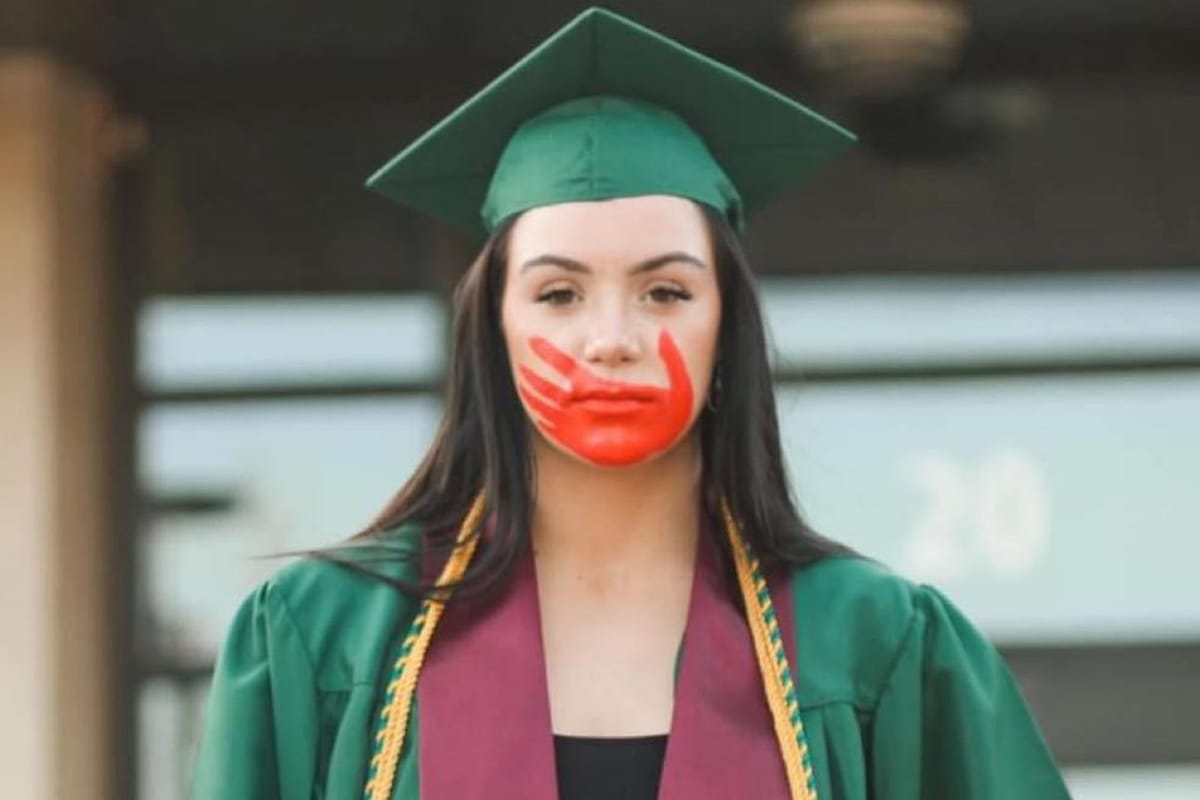
When her daughter Chloe Remington graduated from Norman North High School with honors in 2023, she walked across the stage with a red handprint painted on her face to raise awareness of the MMIP crisis, despite her principal saying he would have her arrested for it.
“I walked up to one of the police officers and I said, are you gonna arrest my daughter if she walks out here on the stage?” Davis said. “And all of her classmates are already on the court, sitting in their chairs, and he said, she's not breaking any laws. I would not arrest anyone for not violating the law. So I walked her to the floor and she walked anyway.”
For Littledeer, the obstacles are not an excuse to negate coverage of issues like MMIP and other issues impacting Native communities. He believes impactful media coverage from tribal press outlets in particular can lead to lasting change.
“If we don't have our own strong media, our stories get ignored or told wrong by outsiders,” said Littledeer. “Good reporting makes it so the public, both inside and outside the tribe, can't just look away when things are going wrong.”
This reporting was supported by the International Women’s Media Foundation’s Fund for Indigenous Journalists: Reporting on Missing and Murdered Indigenous Women, Girls, Two Spirit and Transgender People (MMIWG2T).