Sac and Fox Nation builds relationship with oil industry through Enbridge partnership

(CUSHING, Okla.) Growing up in Cushing, Sac and Fox Nation Council Member Robert Williamson remembers looking through the fences surrounding the city's massive oil storage facilities, wondering what happened on the other side.
“I grew up like a lot of people did in Cushing, Oklahoma, not really knowing what that whole place was, other than oil out there,” Williamson said. “I said, we looked through the fence, looking in there, looking inside from the outside. We were on the outside because we weren't invited in. I mean, nobody said, 'Hey, come on in.'”
Today, Williamson is helping change that relationship through a partnership between the Sac and Fox Nation and Enbridge, one of the companies operating in Cushing, a major global hub for crude oil storage and transportation.
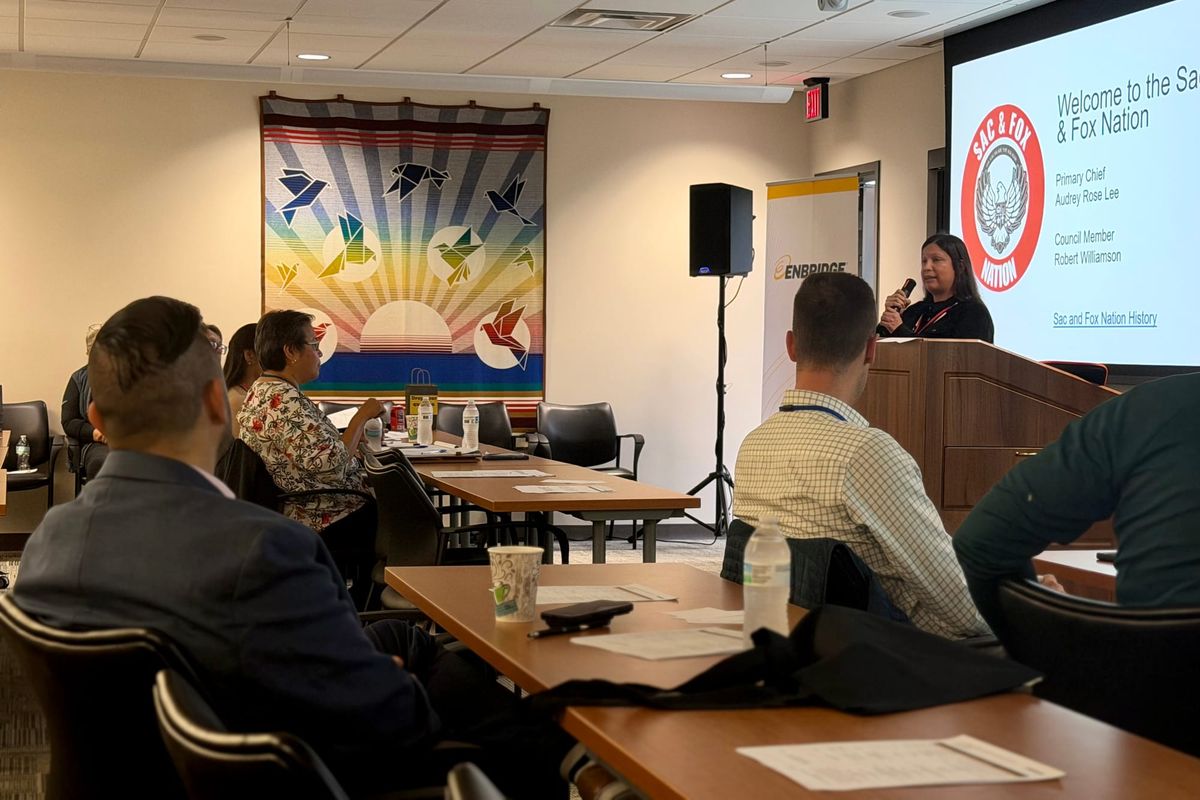
The partnership was highlighted October 14 during Enbridge's 2026 Cushing Terminal Summit and Tour, which brought together leaders from several Tribal Nations to discuss tribal engagement and opportunities within the energy industry.
Leadership from the Sac and Fox Nation, Kickapoo Tribe, Navajo Nation, Osage Nation, Red Lake Nation and Lower Sioux Indian Community amongst others attended the event, which also included a dinner hosted by Sac and Fox Nation leadership.
For the Sac and Fox Nation, the relationship represents an opportunity to have a voice in an industry that has long operated near its communities.
The Nation is among many tribal nations whose ancestral homelands lie outside present-day Oklahoma. The Sauk and Meskwaki (Fox) peoples, historically separate but closely affiliated, were grouped together by the federal government for treaty purposes beginning in 1804. Throughout the 1800s, a series of treaties and federal removal policies displaced the Sauk from their Great Lakes homelands, eventually pushing them to Indian Territory.
“We were loaded up just like everybody's story, I say everybody, I'm talking tribes, loaded up and brought down here,” Williamson said.
Cushing, located within the Sac and Fox Nation's reservation boundaries, is home to one of the world's largest crude oil storage hubs, with numerous companies operating terminals and pipelines in the area.
According to Sac and Fox Nation officials, 22 oil and gas companies operate in the Cushing area, but Enbridge is the only one that has sought input from Tribal Nations, including the Sac and Fox Nation.
Jennifer Smith, Enbridge's director of tribal engagement in the United States, acknowledged that many energy facilities and pipelines were developed without tribal consultation.
“When a lot of this facility, the pipelines, were built across this nation, the tribal nations weren't consulted,” Smith said.
Smith said Enbridge has maintained an Indigenous Peoples Policy for more than two decades and recently updated its Indigenous Reconciliation Action Plan, which guides the company's approach to working with Tribal Nations.
“That gives us our guide, our North Star on how we should, but also how we can work with our tribal nations,” Smith said. “We're trying to build the type of relationship that we have with Sac and Fox here in Cushing across our entire system. And we're on a journey is what we say and, unfortunately or fortunately, we have a long way to go.”
The Sac and Fox Nation's relationship with Enbridge began about four years ago when Williamson started asking around, eventually leading to an invitation to meet with company leadership at its headquarters in Calgary, Canada.
During the visit, Williamson said he was encouraged to speak openly about the Nation's history, its experiences with the oil and gas industry and the exclusion tribal members had felt over the years.
A few weeks after returning from Calgary, Williamson received a call inviting him to serve on an Enbridge advisory board. He accepted, despite some concerns among fellow tribal citizens about working with the company.
Sac and Fox Nation Principal Chief Audrey Lee praised Williamson's willingness to represent the Nation in those conversations.
“He was brave enough to take it because he knew what it means to sit at these tables and to have his voice heard,” Lee said. “You just heard how impactful his words were going up to Canada. So for him to make that step, he wasn't thinking about Robert Williamson. He was thinking about our Nation and our people and our future generations. That's what it means to us.”
Beyond having a voice in industry discussions, Lee said the relationship could create opportunities for tribal citizens to pursue careers in oil and gas.
“We hope for future opportunities for that for our people, because what better way to educate our tribal members is by being a part and having a part into the workforce, into the oil industry,” Lee said. “We want them to go out there and get that knowledge so they can educate our people and our future generations.”
Williamson said he understands why some tribal citizens may be hesitant about building relationships with energy companies, but believes participation can provide opportunities to influence decisions and protect tribal interests.
“I will be one of the first to say I understand what, talking to tribal members, I understand what your concern is,” Williamson said. “But you gotta tell that to them too, the same thing I tell these guys. Don't you want your nephew or your niece to possibly get a decent-paying job and be a part of it to try to protect it? 'Cause there's no need to leave just because something moves in.”
For Williamson, the relationship also reflects the challenge of balancing traditional responsibilities to the land and water with the realities of the modern economy.
“We feel like tribal people, we're working two worlds. We're here, the Creator put us here to be stewards of the land, the water, the living things, every living thing here,” Williamson said. “We're in this cog already and moving forward, there's no stopping it. So the better place to be in this modern world is at the table.”
Enbridge is a Winds of Change Executive Benefactor of Crosswinds News. Through this benefactor program, Enbridge provides financial support to help sustain Indigenous-led journalism and storytelling. However, Crosswinds News maintains full editorial independence, and this article was produced in alignment with our commitment to fair, accurate, and culturally responsible reporting. For more information about the Winds of Change Benefactor Program, click here.