Native community centers helped preserve culture and connection during urban relocation

(TULSA, Okla.) While many Americans picture tribal members living on rural reservation land, more than 70% of Native people now live in urban areas. That demographic shift accelerated in the 1950s, when federal relocation policies uprooted Native families, disrupted communities and, in many cases, contributed to the development of Native community centers across the country.
Donald Fixico (Shawnee, Sac and Fox, Muscogee and Seminole), a Regents professor in the School of Historical, Philosophical, and Religious Studies at Arizona State University, has researched and written about these policies extensively.
In the Federal Indian Relocation Programme of the 1950s and the Urbanization of Indian Identity, Fixico compares the post-WWII federal push for urbanization to forced removal and the Trail of Tears, when tribes were pushed from their homelands in the eastern United States to Indian Territory, or present-day Oklahoma.
The beginning of relocation
In the winter of 1947, the Navajo and Hopi tribes were experiencing a harsh winter in Arizona. Around that time, according to Fixico, the government began experimenting with relocation.
“What the government did was to introduce an experimental program of moving, especially Navajo families, to three areas,” Fixico writes. “One of them is Salt Lake City, the other one is Denver, the other one is Los Angeles. Then the government presumed that it would be a good idea to introduce the relocation program to all Native people.”
The Indian Relocation Act of 1956, also known as Public Law 959, was presented as a way to offer vocational training and improve employment opportunities for Native Americans living on reservations. Native people who participated in the program were given a one-way ticket to the city, and some received a housing stipend.
But the federal program’s long-term aim was the elimination of tribal reservations and the protected trust relationship between tribes and the federal government. According to Fixico, a total of 109 tribes lost their trust status because of termination-era policies like the Indian Relocation Act, which was signed into law by President D. Eisenhower on August 3, 1956.
Oglala Lakota activist Russell Means described relocation more bluntly:
“What the hell was relocation? Eventually, I learned that the [Dwight] Eisenhower administration had come up with yet another plan to depopulate Indian reservations. The idea was to integrate Indians into urban ghettoes so that in a few generations we would intermarry and disappear into the underclass. Then the government could take the rest of our land and there would be no one left to object.”
Employment and isolation
As relocation efforts ramped up, reservations got smaller. Tribal members moved to major cities like Chicago, Minneapolis, and Dallas, and eventually to smaller cities, including Oklahoma City, Tulsa, and Wichita.
Moving to an urban area did not always bring the better economic opportunities the federal government had promised. Native people often struggled to find jobs, with many receiving only seasonal work.
“Sometimes factories closed down and welfare agencies had to aid relocated families,” Fixico wrote. “Promised jobs fell through.”
In addition, job security was hard to come by.
“They were the first ones to be laid off,” Fixico says. “In any kind of company, in any kind of store, for example, you hire your friend. Well, if you don’t have any friends in an urban area, you’re gonna be the last one to be hired. And if you don’t have any skills, then you’re really working at a disadvantage.”
Employment troubles were not the only challenges Native people faced when moving to urban areas. Program participants often left behind their families, communities, and cultural ties.
“If you went on relocation by yourself, it was really a lonely experience,” Fixico says. “But even for families who went, that was still a lonely experience, if you didn't see other people who were like you.”
The role of community centers
To help implement relocation policies, the Bureau of Indian Affairs (BIA) created field offices in participating cities, including Los Angeles, Chicago, Minneapolis and Dallas. Native people could go to these centers to find employment and housing, with varying levels of success.
However, some Native community members recognized a need for centralized centers where Native people could get more reliable support. In Chicago, local Native community members like Susan Kelly Power helped found the American Indian Center in 1953. The center provided a central gathering place where Native people could meet other Native people as they adjusted to urban life.
These newly emerging community centers provided more than just economic and logistical support.
“Bowling teams became very popular,” Fixico says. “Softball teams became very popular. The Indian Center in Chicago had a canoe team. It was really kind of a new Indianization where Native people began to move away from tribal identities towards a generic Indian identity or even an urban Indian identity.”
What about Tulsa?
Long before federal urban relocation policies, Oklahoma had already become home to dozens of tribal nations through forced removal.
During the 1830s and 1840s, the federal government forcibly removed tribes from their ancestral homelands across the Southeast, Great Lakes and Eastern Woodlands to what was then known as Indian Territory. Those removals included the Cherokee, Muscogee (Creek), Seminole, Chickasaw and Choctaw Nations, along with numerous other tribal nations that were relocated to present-day Oklahoma.
Oklahoma is now home to 39 tribes. Tulsa itself sits on the ancestral homeland of the Osage Nation and has longstanding historical connections to the Caddo Nation and Wichita and Affiliated Tribes. The city later became home to the Muscogee (Creek) and Cherokee Nations following their forced removal to Indian Territory, though none of the tribes are headquartered in Tulsa (the Muscogee capital is in Okmulgee, the Cherokee Nation's is in Tahlequah, and the Osage Nation's capital is located in Pawhuska).
A survey conducted by Crosswinds News in early 2026 found a strong desire among Tulsa-area Native people for an intertribal community center close to them. The survey also found a wide diversity of tribal identities represented in the area, extending far beyond Muscogee, Cherokee and Osage Nation affiliation. Survey respondents reported affiliations with over 39 tribal nations, 19 of which are headquartered outside of Oklahoma.
Survey respondents expressed a desire for a Tulsa Native community center designed to offer cultural classes, job training classes and a place to gather, similar to what cities with Native community centers already have.
Erin Parker (Absentee Shawnee) told Crosswinds that she believes a community center would benefit the Native American community in Tulsa.
“The community center could support us by providing a place for us to gather that supports Native organizations and owners,” Parker said. “Right now, we use spaces that are not owned by Native people, and I would like to better support our Native community.”
Amanda Swope, Tulsa’s Director of Tribal Policy and Partnerships, said that a community center would support Native Americans who are disconnected from their culture.
“A Native community center will give people that have lost touch with their tribe or that weren’t raised in close proximity to their culture a place to connect with their roots and to find community beyond their reservation,” Swope said.
Swope also said she is glad to see so much support for a common intertribal space in Tulsa.
“It’s apparent that it is a desire people had in Tulsa for a long time,” Swope said. “Our community wants a place to connect with one another and with their culture, to provide a space where ways that are nearly lost can be reignited.”
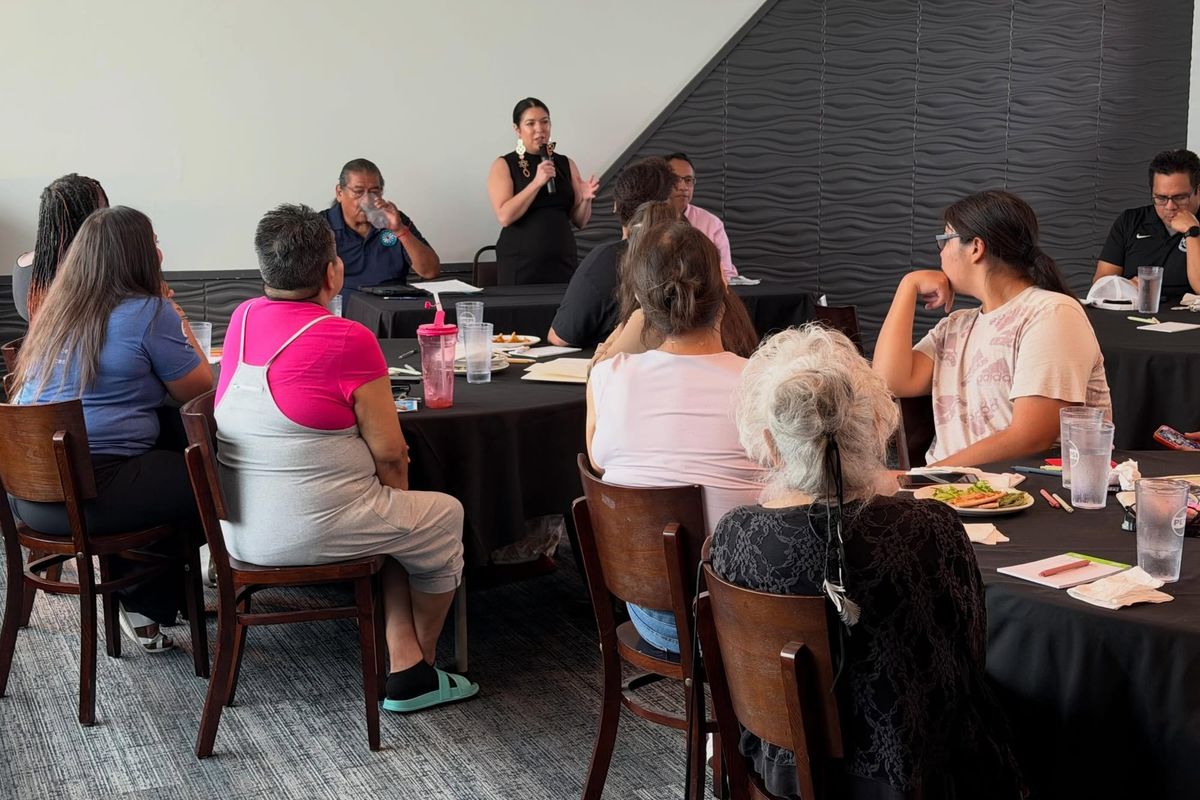
Crosswinds held a community listening session on June 24th to gather input about what a Native community center in Tulsa could look like.
Crosswinds is contacting leaders of other Native community centers in cities like Chicago and Minneapolis to learn how these centers have supported cultural continuity and strengthened connections for urban Native people.
The goal of these conversations is to explore how Tulsa might learn from established community centers as local community members work to develop an intertribal community center of its own.
Crosswinds will also continue to support community conversations about a potential intertribal community center for Tulsa.
This story is the first installment in Native Places, Native Voices, a new Crosswinds series exploring the spaces that strengthen Native culture, connection and community. To learn more and support this work, click here.