Native youth homelessness among Tulsa's most severe disparities, Equality Indicators report finds


(TULSA, Okla.) Native American youth in Tulsa are more than four times as likely to experience homelessness as White youth, according to the city's newly released 2025 Equality Indicators Report. The report identified youth homelessness as one of Tulsa's most severe disparities and one that has worsened since 2018.
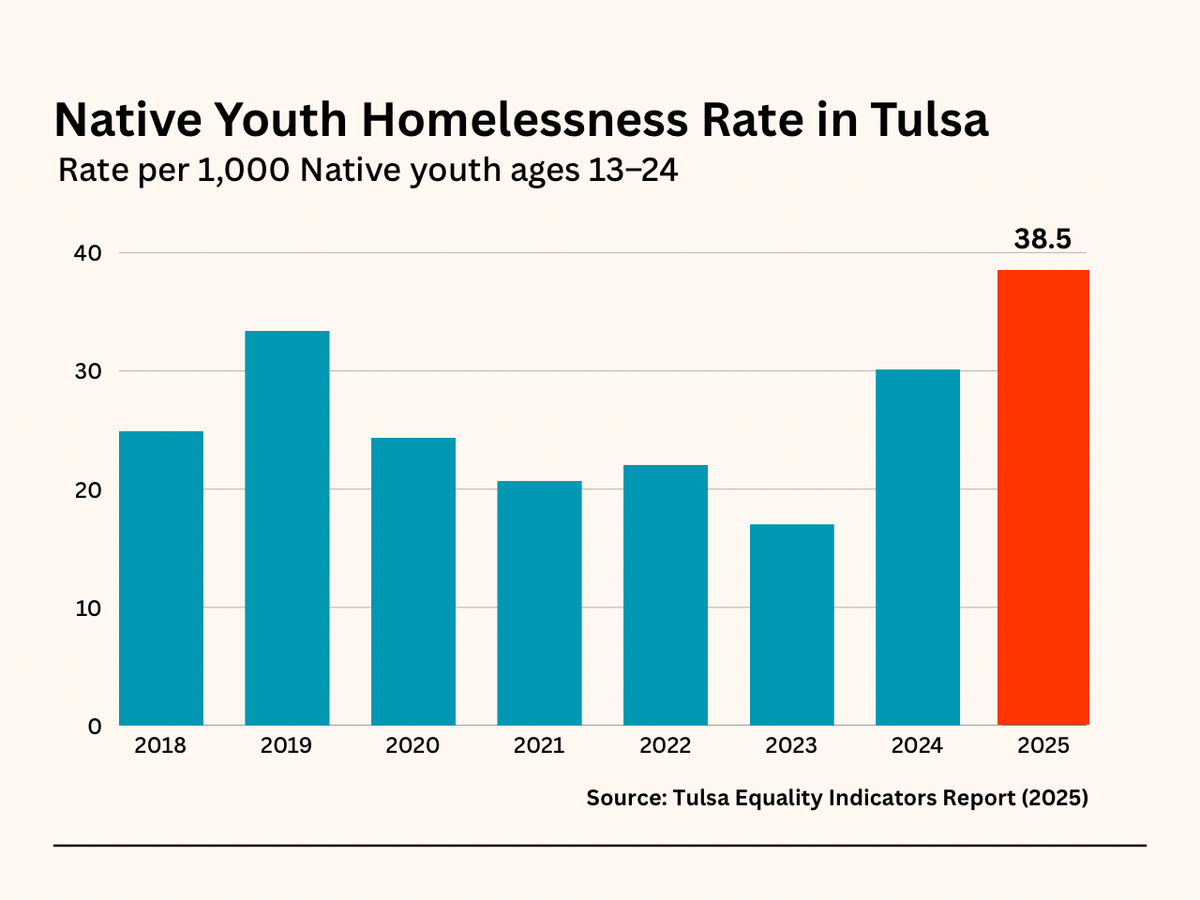
The report found 38.5 Native American youth ages 13 to 24 per 1,000 residents were experiencing homelessness in 2025, compared to 8.9 White youth per 1,000 residents.
The City of Tulsa recently released its 2025 Equality Indicators Report, with the city receiving an overall score of 44.52 out of 100, an increase of nearly six points from its first score in 2018.
The report includes 54 indicators across six categories: housing, education, public health, economic opportunity, services and justice.
In 2018, about 24.9 Native American youth out of 1,000 were experiencing homelessness. By 2025, that number had increased to 38.5 per 1,000.
The overall equality score for Youth Homelessness by Race was 25 in 2025, down 13 points from 38 in 2018.
The report also found Native Americans faced significant barriers to homeownership.
Native applicants were denied home purchase loans at a rate of 23.9% in 2025, compared to 8% for Asian applicants. The overall equality score for Home Purchase Loan Denial by Race was 34 in 2025, down four points from 38 in 2018.
Tulsa Mayor Monroe Nichols acknowledged that while the city's overall score increased, significant disparities remain.
"These indicators are not just about whether numbers improve - they are about whether outcomes are becoming more equal across communities and whether that progress is happening in positive, meaningful ways," Nichols said. "In some areas, this report shows encouraging momentum. In others, it highlights gaps and challenges we still have to confront together."
One area that showed significant improvement for Native Americans was chronic absenteeism in schools.
Native American Tulsa Public Schools students had a chronic absenteeism rate of 42.6% in 2025, slightly lower than Asian students at 43.8%. The report assigned the indicator a perfect equality score of 100.
The improvement was dramatic compared to the years following the COVID-19 pandemic. Chronic absenteeism among Native students reached 57.3% in 2021 before falling to 52.1% in 2022 and 42.6% in 2025.
The overall equality score for Chronic Absenteeism by Race increased from 33 in 2018 to 100 in 2025.
Native students moved from being the disadvantaged group to having slightly better outcomes than the comparison group under the report's methodology.
Although the report contains 22 indicators that compare outcomes by race, Native Americans were explicitly included in only three of them.
Most race-based comparisons focused on Black residents versus White residents, Hispanic or Latino residents versus White residents, and Asian residents versus Black residents.
Because the report's methodology compares a single advantaged and disadvantaged group for each indicator, it is unclear whether Native American data was analyzed but not included in the published comparisons for other race-based measures.
The limited Native representation stands out given Tulsa's large urban Native population and location within the reservations of the Muscogee Nation, Cherokee Nation and Osage Nation.
Historically, Tulsa Equality Indicators reports have relied on datasets that use race-alone categories rather than race alone and in combination with one or more races. As a result, Native Americans who identify as multiple races may not be fully represented in the report. Many Tribal citizens and Native residents in Tulsa identify as more than one race.
The disparities identified in the report also exist within a region built from the legalized theft of Native land and wealth following allotment.
After Native tribes were forcibly removed to what is now northeast Oklahoma, the federal government forced tribal members to select individual land allotments, effectively destroying the tribes’ traditional communal living. Then, courts would commonly determine Native American allottees to be “incompetent” to manage their own land and resources, and guardians were assigned to manage it for them.
The majority of Native allotments and the resources on them were quickly taken once control was handed over to guardians through the county courts, leaving many of the allottees homeless, or worse.
A 1948 congressional report, The Five Civilized Tribes: Progress and Problems, concluded the transfer of probate jurisdiction from federal oversight to Oklahoma county courts "did result in thousands of Indians losing their lands, often to the corresponding enrichment of whites and some mixed-blood Indians."
The report estimated that of approximately 64,000 Native people whose restrictions were removed in 1908, only five to ten percent retained significant property less than two decades later. The report also noted that Native-owned heirship lands continued to be sold at a rate of roughly 10,000 acres per month.
More than three decades earlier, former Commissioner of Indian Affairs Charles H. Burke warned Congress that Native people in Oklahoma were being systematically dispossessed through guardianship and probate systems. In a 1912 speech, Burke said seven-eighths of Native people whose restrictions had been removed were already "without any property or any money" and warned that continued losses would create a future "pauper population."
Related Story: In Oklahoma, theft of Indigenous land was swift and relentless following statehood
While the Equality Indicators Report does not examine the causes of modern disparities, the findings on Native youth homelessness and barriers to homeownership clearly follow a history of systemic Native land and wealth injustice across eastern Oklahoma.
Crosswinds News contacted three Native-serving organizations for comment on the historical and contemporary factors contributing to Native housing disparities and homelessness. This story will be updated if additional responses are received.
"As we look at the path ahead, I remain committed to doing the work necessary to close those gaps and move Tulsa closer to becoming the city we know it can be for everyone," Nichols said.
The city will host a public learning session for residents interested in hearing more about the 2025 Equality Indicators Report on July 7 from 10:30 a.m. – Noon at Tulsa Area United Way, 1430 S. Boulder Ave.
Registration for the event as well as the full report can be found on the City of Tulsa website.